Bliss Plaza

An outdoor courtyard surrounded by a shopping center

The design process for this project
Green wall inspirations
“Shell Petrol Station @ Tampines Avenue 2.” Greenroofs.com, www.greenroofs.com/projects/shell-petrol-station-tampines-avenue-2/.

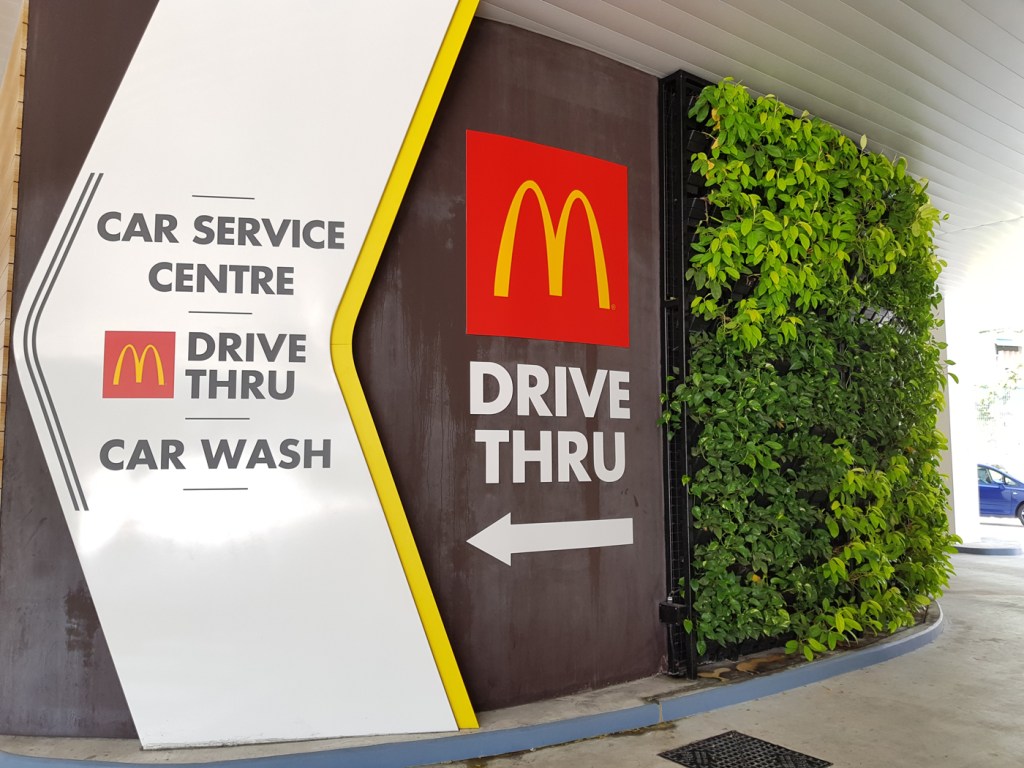
I was thinking about biophilic design: bringing greenery to our living places. Biophilia helps us to work with nature, instead of taking greenery out of where we are. In my research, a website called GREENROOFS.COM from one of the Sustainable Design and Development sections in PPN Professional Links. GREENROOFS.COM did a project called Shell Petrol Station @ Tampines Avenue 2. The green walls improve customer experience and employees’ well-being for nearby businesses especially Mcdonald’s and Shell petrol station. 

“Four panels of Elmich Green Walls totaling 55m2 were established across the station and filled with verdant plants, giving the station a welcoming green façade while simultaneously helping to reduce ambient heat and airborne pollutants. A rainwater harvesting system, projected to save more than a million liters of water per year, helps to irrigate the plants on the green walls, as well as to flush the toilets” (Greenroofs.com 2017).

The project, Shell Petrol Station @ Tampines Avenue 2, shows how much benefits and influence of incorporating the principle of biophilia.
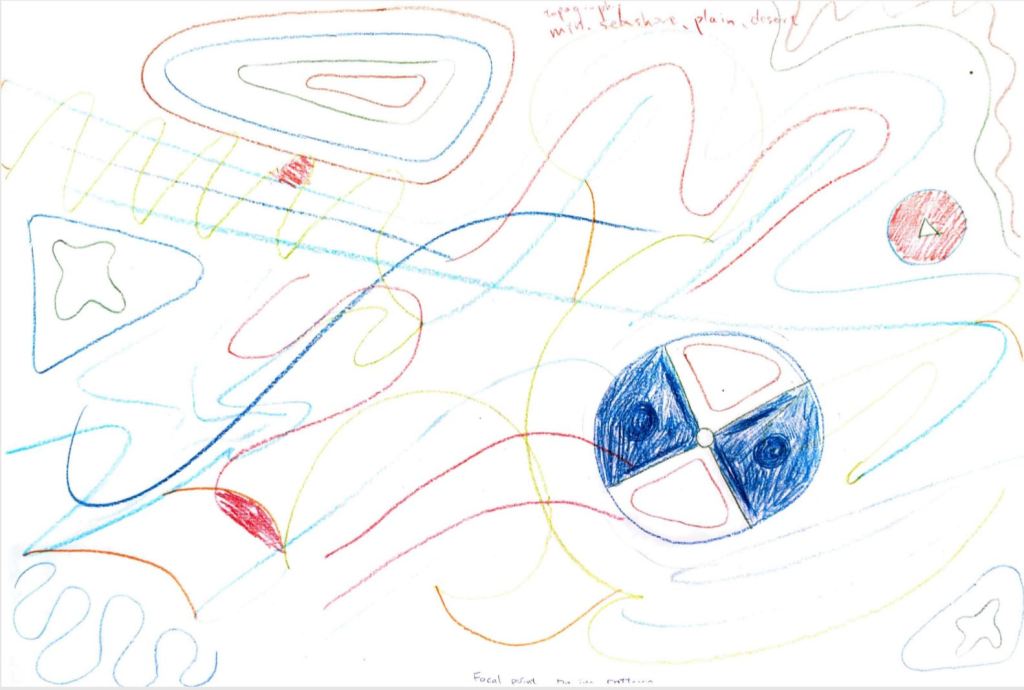
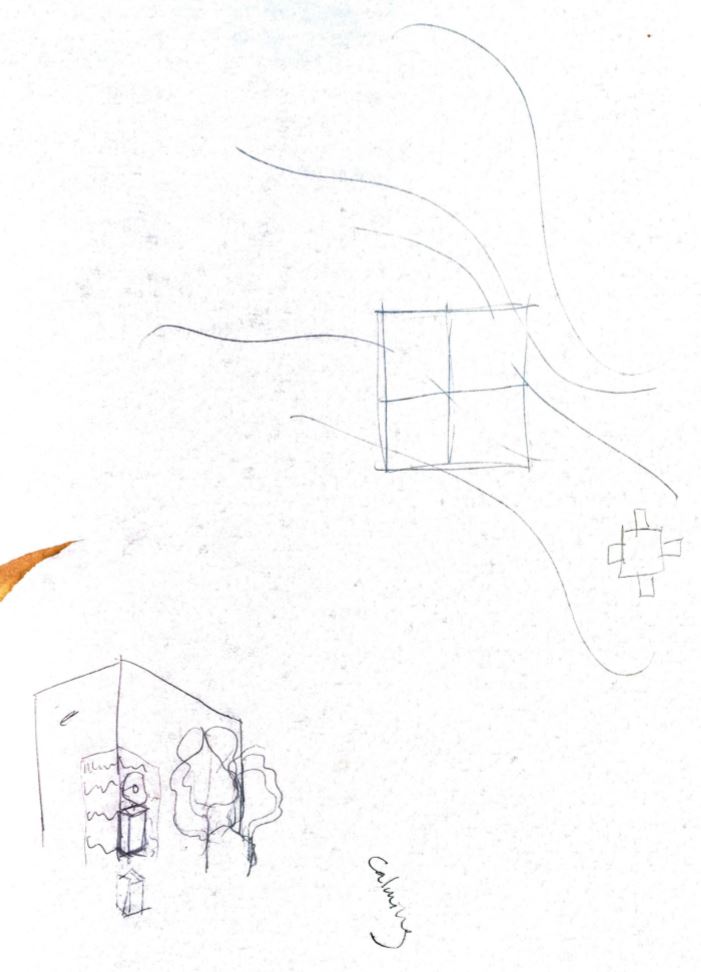
Everyone in my studio was required to draw not more than 5 lines before passing it to the next students

This design exercise gives me both opportunities and constraints

opportunities 

Lots of free forms are created. 

Great way to think outside the box.

Help to overcome Paralysis by analysis-over thinking so I can just start the project.

Different people think of abstract lines differently so it gives me the opportunity to show my own taste and interpretation of those random shapes and lines. 

constraints

Objects might have acute angles.

May have weird positions relative to each other.

Do not have a specific form as a theme, such as circular or angular, which may create a lack of unity.

Theory

Halprin’s theory on nature is about taking how you feel in nature and transforming it into forms that give you the same feeling. 

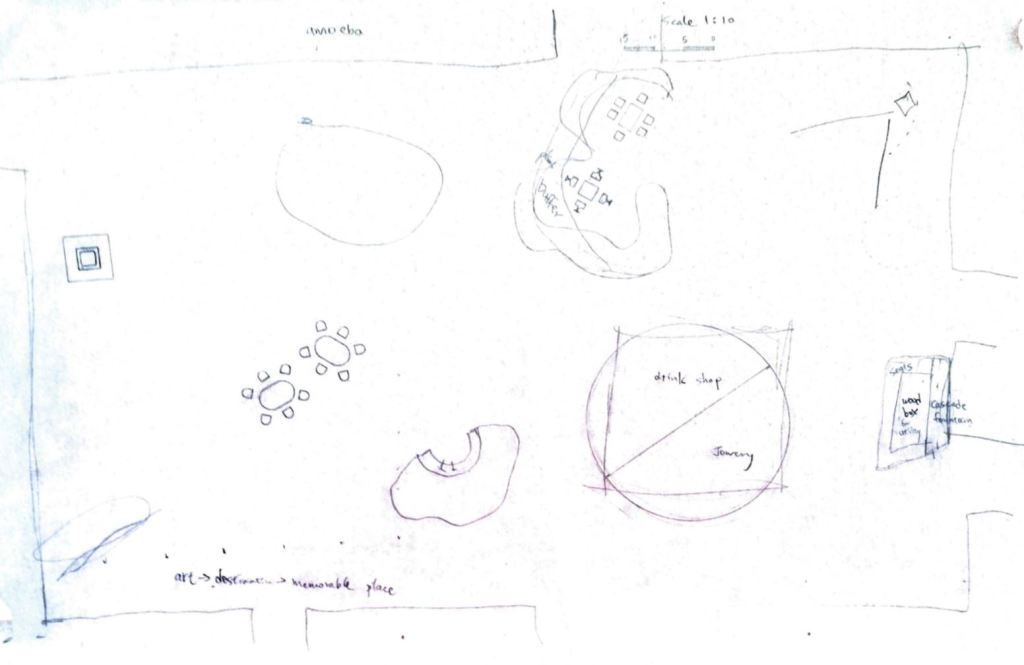
Whenever I visit national parks I feel relaxed and refreshed. My design of planting islands help to make subspaces and bring prospect and refuge just like how humans used to live in the cave. At the same time, they help with circulation in the plaza. The concert is like birds chirping; the water fountain represents a waterfall.

Program/ Story

Art-Destination-Memorable place.

More often our dreams while we are sleeping come from the thoughts we have had, people we have seen, or places we have been. I was visiting some museums and shopping centers during my winter break. When I look at those abstract lines and shapes drawn by my classmates, I feel I’m in a shopping plaza that I enjoy a lot when I’m there. 

When I look at Roberto Burle Marx’s work, it has a very strong paving pattern. It brings intense energy and thrill into a landscape. All the stores around my garden plaza are trying to attract customers. Thus, by making my paving pattern simple and crisp, users will feel relaxed and calm in the space. Those planting islands are inspired by blobby Amoeba to create fluidity and flow in this garden plaza. 

There must be at least a main circulation for the walkway and secondary circulation.

People who live in urban cities tend to have high stress so grasses will be incorporated. Because grasses can dance in the wind and have a soft texture, grasses can calm people down visually. 

Also, the thin needle-like sheaths of grass can reduce evapotranspiration which fits its local Mediterranean climate in California. 

Varieties of seating material, color, texture, and arrangements bring interest to the space, yet they are in harmony with each other in function and visual from the same modern look. 

Having a focal point as a big theme in the space also acts as a way-finder.

There will be an art gallery every Saturday with movable art pieces or sculptures, depending on local artists.

A stage provides an opportunity for jazz bands of 2 to 6 people to entertain the site users. When the jazz band is not performing, the fountain will be on to create a year-round interest between day and night time. 

The fountain calms users’ hearts with its soothing water sounds. 

The design journey continues.

circulation
perspective objects
Final rough draft

Jumping/Cheerful design

My work redesigning University Union Plaza at California Polytechnic State University in my studio class LA402 has continued to progress throughout the quarter. In my title, Vibe of Community Creativity, my vision for this space is to inject a vivacious (jumping/ cheerful) atmosphere in the UU Plaza that evokes the imagination of all. Thus, I aim to create a better social environment. To accomplish this goal, I will incorporate into my design an open space for public art shows that will hold twenty people therefore enhancing the vibe of creativity on campus. Also, I will build a fountain for fish viewing with friends that allows ten people to sit at one time. The soothing sounds of fountains can enhance cognitive function and reduce stress. Cal Poly is not an easy school, if stress is not managed properly, our students could suffer from “depression, schizophrenia, anxiety, exhaustion, and fatigue syndromes” (Wolf, 2018).

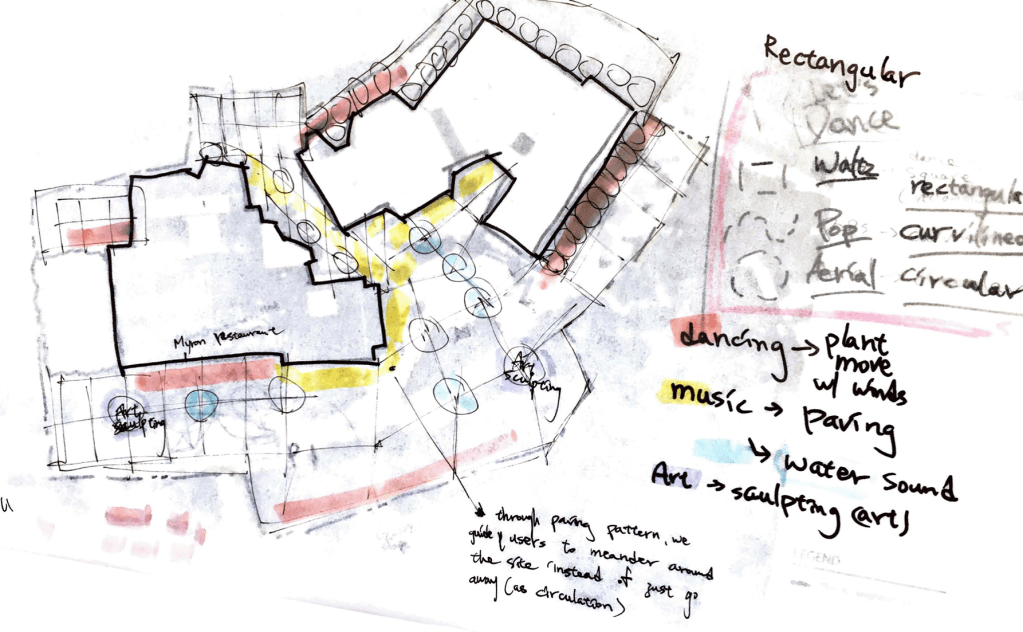
I’m digging through the PPN Professional Links. Green Cities: Good Health appeals to me. After the industrial revolution, hardscape, especially concrete, began to dominate our cities. According to Green Cities: Good Health, shoppers will spend more time in the place if there is lots of greenery (Wolf, 2018). This idea of injecting a vivacious atmosphere inspired three layout concepts based on the movement of dancing. First, the waltz has a more rigid form which will be my rectangular layout. Second, salsa is very fluid which will be the curvilinear form. Third, a circular layout closely resembles aerial dancing as the dancers rotate around with ropes in the air. In my circular theme, I substitute existing brick pavings with shrubs, trees, seatings, and green sculptures. I also bring the outdoors inside and vice versa to make boundaries with greenery more seamless. The eating area I plan to make will seat twenty people and provide them with a private setting. The site users will have greater mental health when they are relaxed and restore their mind (Wolf, 2018). The new design pathway will also require visitors to meander around and have a greater exposure of the site. Therefore, this approach provides more physical exercise for Cal Poly students and creates more mental fatigue recovery time from their stressful studying. 

References

Wolf, K. (2018, August 16). Livable Cities. Retrieved from http://depts.washington.edu/hhwb/

Let’s Dance with nature!
Rectangular (Waltz movement) Art gallery throughout to enhance culture appreciation and mental well being.
Curvilinear (Salsa movement) Redirect circulation to provide additional walking opportunity.
Circular (Aerial Dance Movement) Inside out strategy; removing the boundary line with greenery

Campus design process

In my studio, LA402, we are redesigning University Union Plaza at California Polytechnic State University. University Union is a well functioning site but it lacks the vibe of excitement that every famous attraction has. I aim to create the feeling of downtown San Luis Obispo in this University Union area. Thus, I need to understand campus planning. According to The Society for College and University Planning, “campus planning covers: open space, buildings non-motorized circulation (walking paths, bike lanes, etc.), motorized circulation (roads, public transportation access, etc.), utilities” (Troost, 2020). This list helps me break down each criteria and be more attentive to detail in my design process. 

In addition, there are another set of criteria I need to consider in my campus design. First, facilities: I need to think of what kinds of facilities I would need. Secondly, space management: how much space does each person need if they sit down, walk, dance, chat, or buy products from temporary booths. Thirdly, utilities: where would be a good spot to place water and electric utilities boxes without being an eyesore when I’m designing a fountain. And fourth, sustainability: in my material selections, I would try to design the materials that are durable and local or even using recyclable materials. Fifth, transportation: how does campus police cars, maintenance trucks, and bicycles go through this site. 

In the studio, I have used these concepts when drawing out a perspective of fountains and walkways. All of my drawings use the campus planning ideas from The Society for College and University Planning to give the UU plaza an exciting vibe. I create open space for students to enjoy California sunshine by creating a lawn space with surrounded trees. I also drew fountains to provide seatings for students on one side and the cascade fountains on the other side for visual interest and so water sounds can tranquilize students’ hearts in their stressful studies. I strategically designed circulations not only for people but also for animals, for example dogs and cats. 

2 Campus Design Concepts

References

Troost, Stephen. “Campus Planning.” SCUP, 2020, www.scup.org/  

planning-type/campus-planning/.

Introduction

I want to join Design-Build network because I want to get to know what kinds of designs that get built in our landscapes. I can think of how contractors will build my designs, and I will be more attentive to details when I draw construction documents.

We are going to redesign UU on campus for my studio class with Professor Watts. They are many useful resources in Design-Build PPN websites. In the Associated Landscape Contractors of America website, there is a section about irrigation. They talked about different kinds of irrigation systems, such as rotor and drip, and the advantages and disadvantages of each system. I will be thinking of how my plants will be irrigated and grouped according to their water needs before they are planted. 

http://www.grounds-mag.com/turf/digest/

In the National Arborist web page, I’m intrigued about the tree care section. They teach you how tree pruning, removal, and spraying works; they even teach you about stump removal. As a landscape designer, it is my responsibility to produce a design that would actually work in the long term. 

I love contemporary designs. Most likely my design will incorporate a stone finish, whether it is on the wall or ground. In Natural Stone Institute, there are events and education that I can attend to learn about what kinds of stones are manufactured and their characteristics. I can get to network with stone craftsmen and manufacturers. In addition, I can learn some tips on selecting a natural stone contractor that is skilled and responsible. 

https://www.naturalstoneinstitute.org/designprofessionals/

Lastly, there are so many other resources about Design Build in the PPN websites. I’m very thrilled to design a landscape that would actually work and possibly get built by some of the companies listed on the website. To be a landscape designer who manages the project, one must be able to make creative thoughts into reality. 

https://sfplandscapinginc.com/landscape-design/residential-landscaping-design-services/

Introduce Yourself (Example Post)

This is an example post, originally published as part of Blogging University. Enroll in one of our ten programs, and start your blog right.

You’re going to publish a post today. Don’t worry about how your blog looks. Don’t worry if you haven’t given it a name yet, or you’re feeling overwhelmed. Just click the “New Post” button, and tell us why you’re here.

Why do this?

  • Because it gives new readers context. What are you about? Why should they read your blog?
  • Because it will help you focus you own ideas about your blog and what you’d like to do with it.

The post can be short or long, a personal intro to your life or a bloggy mission statement, a manifesto for the future or a simple outline of your the types of things you hope to publish.

To help you get started, here are a few questions:

  • Why are you blogging publicly, rather than keeping a personal journal?
  • What topics do you think you’ll write about?
  • Who would you love to connect with via your blog?
  • If you blog successfully throughout the next year, what would you hope to have accomplished?

You’re not locked into any of this; one of the wonderful things about blogs is how they constantly evolve as we learn, grow, and interact with one another — but it’s good to know where and why you started, and articulating your goals may just give you a few other post ideas.

Can’t think how to get started? Just write the first thing that pops into your head. Anne Lamott, author of a book on writing we love, says that you need to give yourself permission to write a “crappy first draft”. Anne makes a great point — just start writing, and worry about editing it later.

When you’re ready to publish, give your post three to five tags that describe your blog’s focus — writing, photography, fiction, parenting, food, cars, movies, sports, whatever. These tags will help others who care about your topics find you in the Reader. Make sure one of the tags is “zerotohero,” so other new bloggers can find you, too.

Create your own website, free on WordPress.com.Create your own website.
Start free